
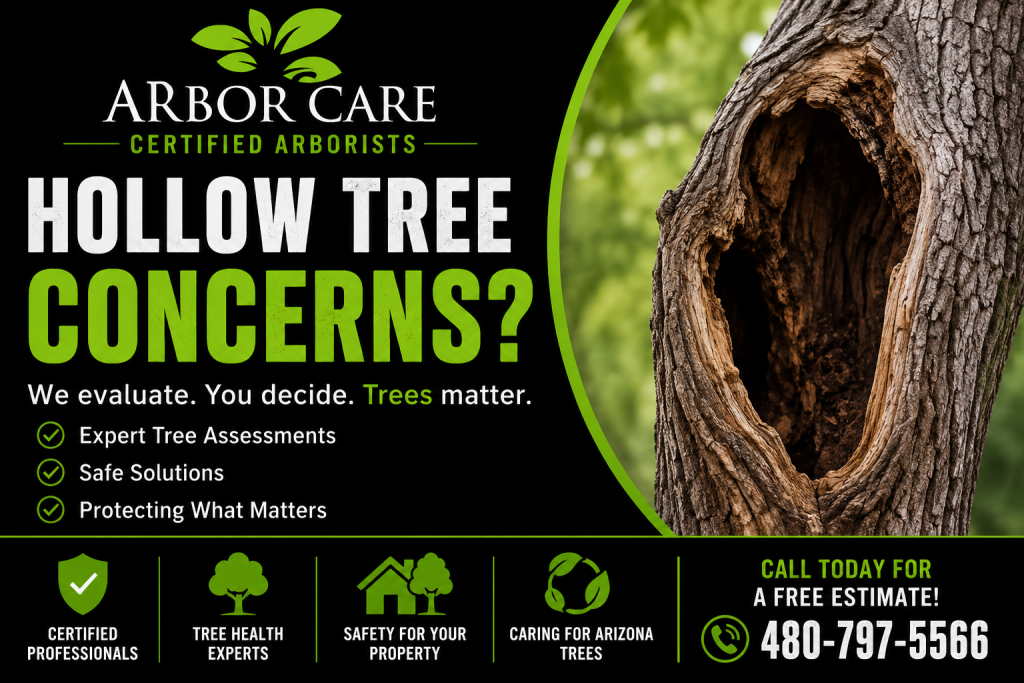
Can a Hollow Tree Be Saved in Phoenix?
A hollow opening in a trunk can make an otherwise green tree look ready to fall. That conclusion is sometimes correct, but not always. Trees can continue growing after the center wood has decayed because the living tissues that move water and produce new growth are closer to the outside of the trunk.
September is a sensible time to inspect mature Phoenix trees after summer heat and storms. A cavity that was easy to overlook in spring may now be larger or accompanied by cracks and dead branches. The important question is whether enough sound wood remains to support the tree safely.
Why Tree Trunks Become Hollow
Most cavities begin with an injury. A large branch may break during a storm, an old pruning cut may decay, or the trunk may be damaged by equipment. Fungi can then move into exposed wood. Trees do not repair injured wood as human skin repairs a cut. They grow new tissue around the wound and attempt to limit the spread of decay.
The center of a mature trunk is largely structural wood rather than the tree’s most active living tissue. That is why a tree with internal decay may still produce a full canopy. Healthy leaves do not prove that the trunk is strong. A tree may remain biologically alive while becoming structurally less reliable.
A Cavity Does Not Automatically Require Removal
The size of the opening tells only part of the story. An arborist also considers the amount and distribution of sound wood, the position of the cavity, the weight of the canopy and the condition of the roots.
Location matters just as much as the defect. A hollow tree in an open area presents a different concern from the same tree beside a home, driveway, playground or busy walkway. The consequences of failure are part of any sensible assessment.
Some hollow trees can be retained with monitoring and selective pruning. Others may need weight reduction, support or removal. There is no reliable household test or simple percentage rule that can replace an inspection.
Warning Signs That Need Prompt Attention
Look for changes rather than relying on one old defect. A widening crack, fresh wood fibers, movement at a branch union or soil lifting around the roots may indicate an active structural problem. Mushrooms or shelf like fungal growth on the trunk or near the base can also be associated with decay.
Dead upper branches, a growing lean and a cavity at the base deserve particular attention. So does a cavity where two large stems meet. These locations carry substantial loads. The International Society of Arboriculture also identifies cracks, cavities, fungal growth and dead branches as warning signs that warrant professional attention.
Keep people and vehicles away when a tree has shifted suddenly or a major crack has opened. Do not stand beneath it to take photographs after a storm.
Do Not Fill the Hole With Concrete
Filling a tree cavity with concrete is outdated. It does not restore living wood or return the trunk to its original strength. Expanding foam may hide the opening but does not improve the structure either.
Avoid scraping deeply into the cavity, drilling a drainage hole or removing firm wood to clean it out. Those actions can enlarge the injury and interfere with the tree’s natural response to decay. Loose material should be assessed carefully rather than pulled away simply to make the trunk look tidy.
Decide What Can Be Preserved Safely
An arborist assessment should not begin with the assumption that removal is required. It should determine the defect, the tree’s ability to carry its canopy and the risk to surrounding property. When retention is reasonable, selective pruning and future inspections may be enough. When the remaining structure is inadequate, planned removal is safer than waiting for failure.
Schedule a Certified Arborist Assessment
Arbor Care provides certified arborist assessments, professional pruning and safe tree removal throughout Phoenix, Tempe, Mesa, Chandler, Gilbert, Scottsdale and surrounding Valley communities. If you have found a cavity, hollow trunk, widening crack or signs of internal decay, call 480 797 5566 for a free estimate and a clear recommendation based on the tree and its location.
Live References
Arbor Care: Certified Arborists and Tree Services
Arbor Care: What Is an ISA Certified Arborist?
Penn State Extension: Understanding the Spread of Decay in Trees
International Society of Arboriculture: Inspecting Trees for Hazards