
Shade trees can make a Phoenix home more comfortable, but problems develop when branches rub the roof, roots disturb paving or the trunk reaches a wall. The right response depends on the species, mature size, structural condition and conflict already developing.
October is a useful time to review these problems. A professional assessment can separate a manageable clearance issue from a location problem that will keep becoming more expensive.
Begin With the Branches Above the House
Walk around the property and look at the roof from several angles. Branches should not scrape stucco, strike windows or rest on roof tiles. Wind movement can damage exterior surfaces and create routes for pests. Dead wood above a roof, patio or entrance deserves prompt attention because it may fall without the warning movement of a healthy branch.
University of Arizona guidance warns that branches rubbing against exterior walls can damage stucco and other surfaces, while contact with a roof can break tiles or damage roofing materials.
Clearance pruning should be selective. Removing every limb on the house side can leave the tree unbalanced, expose shaded bark and encourage weak new growth. The objective is to address the conflict while preserving a stable canopy.
Check Whether Roots Are Causing Damage
Roots usually spread well beyond the trunk through the upper soil. When a large tree is squeezed between a wall, driveway and house, roots may lift paving, interfere with irrigation or grow around underground services.
A crack near a tree does not prove that roots caused it. Concrete can move for several reasons. Visible lifting, displaced edging and repeated plumbing problems are reasons to investigate the site rather than cutting roots on sight.
Large roots close to the trunk may contribute to anchorage. Removing them without understanding their function can weaken the tree and increase the chance of failure. The University of Arizona advises placing trees where mature roots and branches cannot damage buildings, sidewalks or utility services.
Measure the Space the Mature Tree Needs
A young tree may have fitted the planting area perfectly twenty years ago. Its mature canopy and root system may now exceed the available space. University of Arizona guidance warns that trees planted in unsuitable locations can damage roofs, walls, sidewalks and utility lines, eventually forcing repeated pruning or removal.
A small desert tree and a large eucalyptus have very different mature dimensions. Species, growth habit, soil conditions and previous pruning all affect what can reasonably remain.
The answer is rarely to cut every tree down merely because it is close to the house. Well placed shade can reduce heat reaching a home. The real issue is whether the tree can continue providing that benefit without repeated property damage or unsafe pruning.
Treat Utility Lines as a Separate Safety Issue
Never prune a tree that has grown into electrical distribution or transmission lines. Arizona Public Service states that only an approved contractor should trim around its high voltage lines. Contact the utility so its forestry staff can assess the situation.
The tree crew also needs to know where telephone, cable and service lines run. Underground utilities should be located before root work, stump grinding or removal begins.
Know When Pruning Can Solve the Problem
Pruning may be practical when the tree is healthy, the trunk has adequate space and only a limited number of branches require clearance. Regular maintenance can keep growth away from a roof, fence, pool or driveway without ruining the canopy. Arbor Care describes structure clearance as pruning foliage away from buildings, fences, pools and other property features.
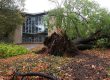
Removal becomes more likely when the tree has serious decay, unstable roots, a worsening lean or a mature size fundamentally incompatible with the site. Repeatedly cutting major limbs to force a large tree into a small opening is not a lasting solution. A better suited replacement may cost less over time.
Plan the Work Before Damage Increases
Do not wait until a limb breaks a tile or roots create a severe trip hazard. Photograph the conflict, note recent changes and arrange an assessment before authorizing aggressive pruning or root cutting. A planned response gives the tree a better chance when it can be retained and makes removal safer when it cannot.
Get a Practical Tree Clearance Plan
Arbor Care provides structure clearance pruning, certified arborist assessments and safe tree removal throughout Phoenix, Tempe, Mesa, Chandler, Gilbert, Scottsdale and nearby Valley communities. If a tree is touching your roof, crowding a wall or creating root concerns near your home, call 480 797 5566 for a free estimate and a practical plan based on the tree’s health, size and location.